Guide
RGB vs RGBW Permanent Lighting: What the Extra White Channel Changes
RGB permanent lights make every color, including white, by mixing red, green and blue. RGBW lights add a separate white emitter, so white can come from a white LED instead of a mix. That mostly matters for everyday architectural lighting, when white is on for hours at a time. It is not an automatic win: implementation, brightness and color quality vary by product, and well-made RGB systems can look very good.
How RGB lights make white
An RGB light has three emitters. Turn red, green and blue on together in the right balance and your eye reads the result as white. Shift the balance toward red and green and it reads as warm white. This is how RGB systems offer white presets.
The catch is that RGB-mixed white is made of three narrow bands of color rather than a broad, continuous spectrum. It can look white when you look at the light itself, but surfaces lit by it may not look quite natural. Stone, brick and wood can appear flatter or slightly off-color, and small differences between emitters can make neighboring lights look a little different.
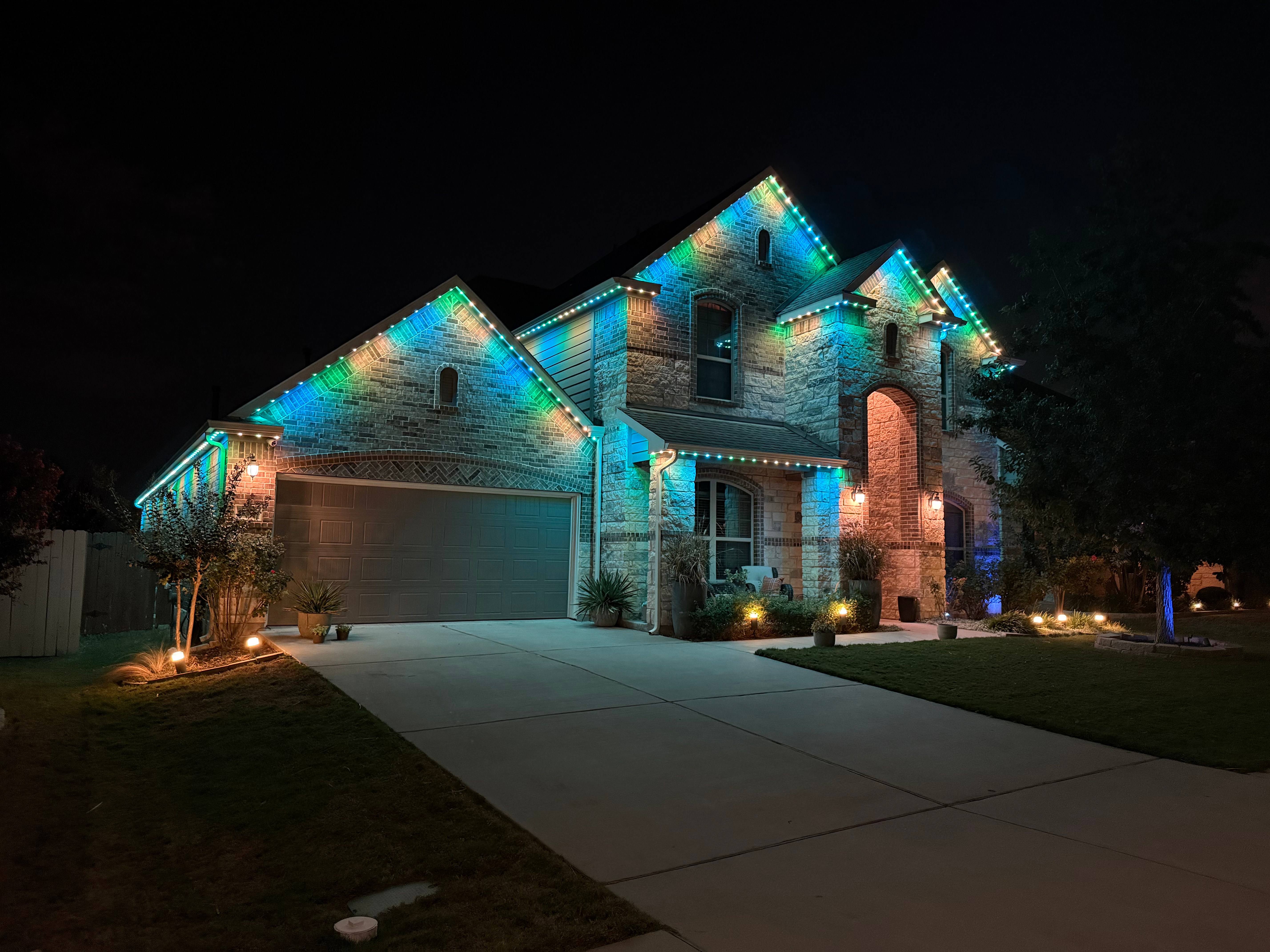
What a dedicated white channel adds
A dedicated white LED produces a broad spectrum on its own. That generally renders surfaces more naturally and keeps white more consistent from light to light. Producing white from one emitter is also often more efficient than driving three colored emitters at once, though actual efficiency depends on the product.
The white channel does not add new colors. Holiday reds, greens and blues still come from the RGB emitters. What RGBW adds is a better option for white, plus the ability to soften or tint white with a little color.
RGBW, RGBWW, RGBIC: what the labels mean
| Label | What it usually means |
|---|---|
| RGB | Red, green and blue emitters. Colors and white are both mixed from these three. |
| RGBW | RGB plus a dedicated white emitter. The white may be warm, neutral or cool depending on the product. |
| RGBWW / RGBCW | Usually RGB plus two white channels, such as warm and cool white, so the white can be tuned. |
| RGBIC | “IC” usually means individually controllable chips or segments, so different parts of a run can show different colors at once. It says nothing about white. |
| RGBWWIC / RGBICWW | A combination of the above. Manufacturers use these labels differently, so check what the white emitters actually are. |
Even among RGBW systems, the white can be built differently. Some put a white diode inside each color LED package; others, like TruLight, use separate full-size white LEDs alongside the color LEDs.
These labels are marketing shorthand, not a standard. Two products labeled RGBW can use very different white emitters. The spec sheet and a look at the lights at night tell you more than the label.
Warm white vs cool white on a house
Warm white, roughly 2700K to 3000K, is a common choice for architectural lighting because it complements stone, stucco, wood and most paint colors. Cooler whites, around 4000K and up, look crisper and are sometimes used for security or modern exteriors, but they can make warm-toned materials look harsh. Exterior materials matter: the same light can look golden on tan stucco and slightly pink on red brick.
How common systems are published
| Product | Published color system |
|---|---|
| TruLight roofline system | RGBW: 3 RGB LEDs + 3 dedicated warm-white LEDs per light |
| Trimlight Classic and 3L | RGB (1 and 3 LEDs per bulb respectively) |
| Bosso Smart Lighting | RGBW: 3 LEDs per light, each with red, green, blue and white diodes |
| Gemstone Lights track lighting | RGBW: 3 LEDs per light, each with red, green, blue and warm-white diodes |
| JellyFish Smart Eave Lights | Full-spectrum RGB, 3 diodes per light, with warm-white presets in the app |
| Govee Permanent Outdoor Lights Pro, Prism and 2 Pro | RGBWWIC, with tunable white ranges that differ by model |
From each manufacturer's published materials, checked October 4, 2026. Sources are linked on the comparison pages for Trimlight, JellyFish, Bosso, Gemstone and Govee.
What to ask an installer
- Is white produced by mixing RGB, or by a dedicated white LED? How many white LEDs per light?
- What color temperature is the white, and can it be adjusted?
- Can I see the white at night on a home with materials like mine?
- How bright is each light at full output, and how was that measured?
- Will I mostly use white, color, or both? Which system fits that use?
TruLight is one RGBW implementation, with three RGB plus three dedicated warm-white LEDs per light. See the TruLight specifications or how pricing works. We install in Boise, Eagle, Meridian and across the Treasure Valley.
RGB vs RGBW FAQ
What is the difference between RGB and RGBW lighting?
RGB lights have red, green and blue emitters and make white by mixing them. RGBW lights add a separate white emitter, so white can come from a white LED instead of a color mix.
Can RGB lights make warm white?
Yes. RGB lights can mix a light that reads as warm white, and many systems offer warm-white presets. The difference is how that white is produced, which can affect how it looks on surfaces and how consistent it is from light to light.
Is RGBW always better than RGB?
No. A well-designed RGB system can look better than a poorly implemented RGBW one. RGBW gives a system the option of producing white from a dedicated white emitter, which matters most if you plan to run white lighting often.
What do RGBWW and RGBWWIC mean?
Naming varies by manufacturer. RGBWW usually means RGB plus two white channels, often warm and cool. “IC” usually refers to individually controllable chips or segments. Check the spec sheet for what the white emitters actually are.
What white color temperature works best on a house?
Warm white, roughly 2700K to 3000K, is a common choice for architectural lighting because it complements stone, stucco, wood and most paint colors. Cooler whites look crisper but can feel harsh on warm-toned materials.
Related comparisons
- TruLight vs TrimlightRGBW vs RGB roofline bulbs.
- TruLight vs JellyFishDedicated white vs warm-white presets.
- TruLight vs GoveeProfessional RGBW vs DIY RGBWWIC.
- 12V vs 24V vs 48VThe other spec homeowners ask about.
- Permanent lighting in BoiseWarm white on Boise rooflines.
- Request a quoteSee white light on a real house.
See the Difference at Night
Request a free consultation and compare white light on your own home's materials.